Posts

THE AGE OF THE UPANISHADS:-2.

Image
Philosophy:- The eternal impersonal  absolute is the ultimate reality; this the Upanishads call Brahman. Of this we have no conceptual knowledge. MAYA is the power by which that Reality  appears to us as the changing Universe under conditions of time and space without actually undergoing any changes in itself. The cause and effect  relationship cannot be applied to the Absolute and the created universe. The Spirit in man is identical with this absolute Supreme Spirit. Our suffering is due to our  not realising this identity. Moksha [ Moha  kshayam/ reduction of desires] or Liberation from suffering can be had through Jnanam; realisation as a result of DYANAM on the Absolute. KARMA and UPASANA ARE VITAL AIDS IN THE PROCESS.[ TO BE CONT---D] By Swami Chinmayananda.
Image
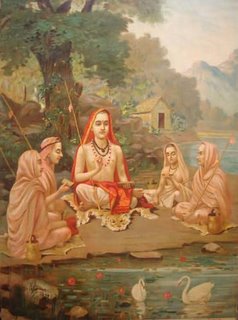
THE AGE OF THE UPANISHADS:-1. Literally meaning  "secret teaching,"the Upanishads embody a number of treatises which represent the cream of vedic thought. In broad terms their teaching marks a reaction against the ritualism of the Brahmans. The first Hindi renaissance is seen in the age of the Upanishads. It was in this age that the foundation of Hinduism were truly laid; all the later developments wee only superstructures built on the foundation. The childish delight in power and possession of the place of Yjnas. Karma was given a wider meaning than mere  ritual. Varnas and ashrams were pushed into the background. But by its very nature this religion was severely individualistic; hence, it could be only the religion of few.    
Image
THE PERIOD OF VEDAS:-3. THE MANTRAS AND BRAHMANAS:- An important  development in this age was the conception of the cosmic order --rta. Later the cosmic order was identified with a moral order. It was believed that the rta was maintained by the offering of sacrifices. This is the period of the Mantras (hymen or religious songs contained in the Vedas). Gradually sacrifices gained prominence, and the period of Brahmanas ( section of the Vedas dealing with rites and rituals) saw a purely sacrificial religion of mechanical nature and a special class of professional priests who alone could officiate at them. This period marks the emergence of Varnas ( classes)m and ashramas ( stages of life). It was only natural that in this period the priests became supreme and powerful in society.[ to be cont---d] By Swami Chinmayananda.   
Image
THE PERIOD OF VEDAS:-2. We cannot precisely estimate the age of vedas; yet some scholars estimate it to be anywhere around 4,000 to 2,500 B.C. It will be of interest to look briefly into the various developments that took place from the vedic age up to the time of SANKARA who, according to general acceptance by scholars, was born in A.D. 788. A truly religious mind does not bother much for the history of religion, but an imperfect historical treatment of a subject has its own value. For purpose of analysis, the earlier period consisting of about 1,500 years i.e, from 2000 to 500 B.C., may be called as the vedic age. In the period of early hymens there was nothing other than the forces of nature to be worshipped. This led to the personification of these forces. Nevertheless, there was a resolute search for a unity behind these forces; hence, we find so many idols created during this time that one god shades away into another. Some of the popular names include Visvakarma, the chief ...
Image
THE PERIOD OF VEDAS:-1. The vedas are the earliest source of information on Indian thought. They are supposed to have emerged out of "OM". They contain the most astonishing record of the march of the human mind from the worship of the forces of nature to the realization of the absolute spirit. This is indeed, a happy pilgrimage. In the the Rig Veda  we find inspiration in the strength of action; in the Yajur Veda, the power will; in the Sama Veda, that knowledge; and in Atharva Veda, that of the mental functions of life. [to be con----d] BY SWAMI CHINMAYANANDA. 
Image
OUR MODERN GENERATION:-6. The flood of human enthusiasm gushing down the wrong channels is dangerously eroding the peace and joy, equanimity and tranquillity , sincerity and self confidence, tolerance and forgiveness from the human bosom. We can, as an item of the spiritual festival  conduct an attempt some well known pundits of Hinduism,Christianity, Islam, etc; on the same platform. But the function go well off and the its benefits are nil. Unless the very champions  of the various religions themselves are convinced of the glory of their religion and unless such convinced saints and sages have ample compassion for the despairing world, such meetings cannot be helpful to the ordinary citizens.  
Image
OUR MODERN GENERATION:-5. In a recent review it is estimated that few percent of the world population are today suffering from mental diseases while relatively in our own poverty--stricken nation the percentage of people suffering from similar illness is only less. Not that we are religious; and yet, even the confirmed atheist in Bharat unconsciously lives some religious and philosophical values of life. It is time that philosophy and religion walked out of our libraries and temples to serve the age. Even in this age, there are very many unhealthy trends today. The confusions of the era seem to have contaminated even the viewpoint of the various religious followers. Sometimes one is surprised to see the fanaticism, competition, jealous ies, and rivalries  between the champions of different religions, than among the leaders of the nation or proprietors of firms or even among the members of the community.  It is time that the heads of religions come together into a b...