Posts

1. Viswamittra Mahrishi :

Image
Ancient Rishis of Bharatham :1.  The three chief classes of Rishi are the Brahmarshi, born of the mind of Brahma, the Devarshi of lower rank, and Rajarshi or Kings who became Rishis through their knowledge and austerities, such as Janaka, Ritaparna, etc. The Shrutarshi are makers of Shastras, as Sushruta. The Kandarshi are of the Karmakanda, such as Jaimini.  Sapta rishis are two Sanskrit words meaning "Seven Sages".  Some of the great Rishis (sages) of India are:   1. Viswamittra Mahrishi : Rishi Viswamitra is considered to be one of the most revered rishis (sages) of the ancient India. As per the holy Puranas, there have been only 24 Rishis in India who have the Gayatri Mantra. It is believed that Sage Vishwamitra is the first saint of the 24 saints, and Sage Yajnavalkya the last. He also claims the distinction of being the author of the majority portion of the Mandala 3 of the Rig-Veda. Read on to explore the biography of Sage Vishwamitra furth...
Rishi Dattatreya :

Image
: The story of Dattatreya is told in many Purana-s, and this is from the Markandeya purana (chapter 15). A brahmin named kaushika was enchanted by a courtesan and lost his wealth, health etc. However, his wife, Shandili was faithful to him. She even carried him on her shoulders to the courtesan's place. Once, by mistake, she stepped on Sage Mandavya and the sage cursed both of them to die by sunrise. Shandili prayed and appealed that the sun may never rise so that her husband would live. Her prayer was answered and the devas were in an uproar seeing the world order of time destroyed. They asked for the help of Anusuya, the wife of sage atri, to convince shandili. Anusuya was able to convince shandili on the condition that kaushika would live on sunrise. In appreciation of Anusuya's intervention, the gods granted her three boons. She asked for her liberation, her husband's liberation and that the three gods Brahma, Vishnu and Shiva be born as sons to her. The wish...

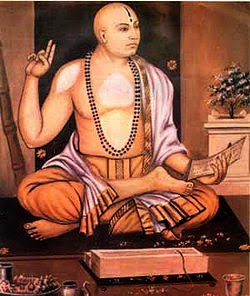
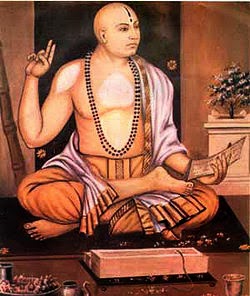
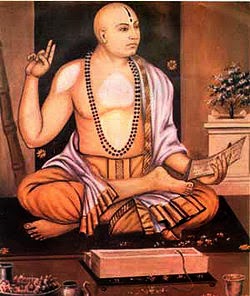
Sri Madhvacharya -5.

Image
Sri Madhvacharya had many disciples belonging to the Sanyasa ashrama and many disciples who were house holders. He vanished from the sight of men in his eightieth year in the month of Magha on the 9th day of the bright fortnight while he was teaching the Aitareya Upanishad Bhashya to his disciples. A shower of flowers is said to have rained on him and he vanished from the sight of men in the shower of flowers. Sri Madhvacharya has written in all thirty seven works. and they are collectively called Sarvamula. Four of his works are on Brahmasutras, two on Bhagavad Gita, ten are the commentaries on ten Upanishads, one on the Mahabharata and one on the Bhagavata in order to determine their import and ten are the prakaranas. The Rigbhashya is a commentary on the Rigveda (for a few typical Riks). Seven of his works are of the Stotra type. Nobody can fail to be impressed by his works. His method is very brief and simple. His logic is infallible and energetic. The depth of his scho...

Sri Madhvacharya :4.

Image
The Pandits were defeated in the debate and with the conviction of the truth of the school of philosophy expounded by Purnaprajna, both of them became his disciples taking up Sanyasa. Shobana Bhatta became the famous Padmanabhatirtha who succeeded to the pontifical seat of Purnaprajnacharya. Samasastry became Narahari Thirtha and at the behest of the acharya stayed behind to obtain the images of Mula Rama and Sita from the treasury of the local prince. Padmanabha Tirtha followed his master and was greatly devoted to him. After his return to Udipi Purnapragna began to write various works establishing the new system of philosophy which has come to be called Dwaitasiddhanta. The cardinal point which distinguishes his system from others is the essential difference between Brahman who is Independent and all else which are dependent. This system has therefore come t be called Dwaitasiddhanta (the philosophy of Basic difference), Purnaprajnacharya declares himself at the end of ma...

Sri Madhvacharya :3.

Image
"A true saint" :  Sri Madhvacharya, right from his childhood, showed signs of divinity. He was completely detached towards mundane worldly pleasures. This was natural to him as he was always immersed in meditation of the Almighty. At a very young age he made his mind to renounce this world and accept sainthood. This, he thought, is the best way to fulfill his life's objective of uplifting the noble souls by imparting divine knowledge. Though decimating evil forces is the prime objective in all his incarnations he knew that by the will of God, Goddess Durga will incarnate in the near future for that purpose. Thus, unlike his previous two incarnations where he single handedly destroyed most of the evil forces he chose to launch a peaceful attack through his works and discourses. "An ardent devotee" : Madhvacharya's devotion towards Vishnu is unflinching and insurmountable. He is the best example of a true devotee of the Almighty. He doesn't ev...

Sri Madhvacharya : 2.

Image
Nahi jnanena sadrisam pavitramiha vidyate. Knowledge is incomparably pure. Thus says the holy Bhagavad Geeta. Our life is a gradual march towards purity – the purity which is the souls own nature. This purity can be achieved only by pure knowledge. Therefore, knowledge is the greatest treasure of the mankind. It is the panacea of all our evils. It is the knowledge which makes man superior to other God's creations. Human being minus knowledge is just an animal with two legs. The world has seen many seers, who came down to earth, to propagate the divine knowledge among the needy. But for them, the world would have drowned in the vast oceans of ignorance. After the advent of Kali Yuga, the noble souls lost their way in the dense forests of samsara. They sank to great depths of ignorance, doubt and bewilderment. The graceful Vishnu was moved by their plight. He wished to uplift his devotees and bring them back to the right path. As He has no avatar in Kali Yuga, He Himself d...

Sri Madhvacharya :1.

Image
Sri Madhvacharya was born in the year 1238 A.D, on the Vijayadashami day of the month of Aswayuja in a village about three miles from Udupi in South Canara. His father was a pious brahmin belonging to Bhagavata Sampradaya and a pauranic by profession. Sri Madhvacharya was born at a late period in his father’s life after constant prayer and dedication of vows to Ananteswara in Udipi. Madhyageha Bhatta, the father, was therefore happy and proud in no ordinary degree in his son whom he christened Vasudeva. Boy Vasudeva was very precocious and his father taught him the three Rs in the privacy of his house. Not even had the boy attained his teens, when he felt an inner urge he could not resist, to taking to the holy orders and took sanyasa under Achutaprekshacharya in Udipi. Achutaprekshacharya had been brought up in the then current Adwaita school of thought but the philosophy of that school did not appeal to the new sanyasi. Achutaprekshacharya was somewhat displeased with...