Posts

THE AGE WHICH SAW SANKARA-2

Image
Bharatham (India) was thus through great intellectual, spiritual and social turmoil. Vedik religion had become mere performance of elaborate rituals as advocated by the Purva-Mimamsa, which took into consideration only Brahmana portion of the Vedik lore. Buddhism was past its heyday of freshness and purity, and had degenerated into innumerable philosophical schools and as many corrupt  religious practices. Jainism was getting a lot of royal patronage and Hinduism had developed a number of intolerant sects. Squabbles, dissensions and corruption prevailed in the name of religion. It was into such an age of fuming confusion, chaotic intellectual anarchy and social decadence that BHAGAVAN  SANKARA  was born to destroy the wicked and the crooked ways of thinking, establish Sanatana Dharma, and impart to it the life-giving  philosophy of the Non-dual Brahmam of the Upanisads. [to be cont---d] By Swami chinmayananda.

THE AGE WHICH SAW 'SANKARA':-

Image
The age which saw the advent of Sankara was the dark period of unrest and strife. The country was divided into number principalities which had very little in common between them. There were literalists and ritualists, on the one hand, who held to the letter of the scriptures missing their message, while on the other, there were powerful nihilists and iconoclasts ready to tear and destroy all that was sacred and ancient. Clinging to narrow conceptions of godhood and swayed by fanaticism, they used religion as weapon of aggression instead of finding in it the solace of life. The society was infested with heinous practices which were given religious sanction by the culturally decayed populace. This was brought  about by the uncultured uneducated mass of people who had embraced Buddhism but who could not appreciate or live up the great and noble ideals preached by the Buddha. The land had no religious Master, and the population drifted without a goal, stagnating in innumerable sect...

SANKARA:-

Image
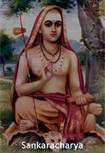
About the middle of the 7th century A.D. Buddhism was in a state of decline. Its final defeat is attributed to Kumarila Batta and Sankaracharya. Kumarila was the founder of the Bhattapada school of Karma-mimamsa and was a great opponent of Buddhism. For his hand, he took the Vedas and vedik rites as the basis. Sankara who lived in the later part of the 8th century and the earlier part of the 9th century completed the work started by Kumarila, and much more.  Sankara assimilated some of the good points of Buddhism. Never deploring the Vedik rites and rituals , he purified them by removing those parts which are misused. He erected the edifice of Advaita and established  four monasteries  as centres of religious teaching and missionary work. These mathas,to this date, are the sources of light and wisdom to millions of Hindus.

THE STATE OF HINDUISM :- 3.

Image
EPICS AND PURANAS:- The subsequent years saw the growing popularity of the Epics and Puranas. They were the most valuable for the common people and formed the source of half of the vernacular literature. One of the significant  developments in the advance of the religious thought in the Puranas was the doctrine of  Avataras  and the concept of  Sakti  personified as the Mother Goddess.   Saktism gave rise to a mass of religious literature known as Tantras. Unlike the Puranas  they contain more of ritualistic matter and less of legend and history. The period up to above 7th century A.D. may be called the period of the puranas and dharshans. This period saw the compilation of eighteen great puranas, the famous dramas of Bhasa and Kalidasa and other commendable masterpieces like the mathematical treatise of Aryabhatta, the  astronomical  treatise of Varahamitra, etc. The Silpa sastra is also ascribed to this period.

THE STATE OF HINDUISM :-2.

Image
There were many significant developments upto about the 3rd century A.D. the most important being the code of Manu. The Mahagana scripture of this period ( Saddharma Pundarika) is known to be a parallel to the Bhagavad-Gita.  A number of Puranas  were written. The religion of Upanisads was thus made simple for the understanding of the common people and was more widely accepted. This can be seen as a reaction to the Buddhist fanaticism . The six schools of philosophy emerged distinctly. The famous literature of this age include Patanjali's Mahabhasya  and Bharata's  Natyasasta.( to be cont------d).    

THE STATE OF HINDUISM:-1.

Image
Both Jainism and Buddhism claimed large followers from time to time, but the majority of the Hindus still clung to Brahmanical Hinduism. The significant development around 200 B.C.; were the development of the creeds of Saivism and Vaishnavism. This period, from the birth of the Buddha to 200 B.C., may be considered as the age of the systematic development of Vedangas, the Sastras, Kautilya's Arthasastra, Jataka tales, etc.[to be cont-----------d] BY Swami chinmayananda 

BUDDHISM:-

Image
The Buddha only restated the thought of the Upanisads. He spread only the ideals of the orthodox religion, but repudiated the ascendancy of the priests  and the elaborate ritualism. Consequently, more emphasis was placed on morality. Dr. Radhakrishnan rightly claims : 'He was the wisest and greatest and best of the Hindus' Thus the emergence of Buddhism may be regarded as the second renaissance of Hinduism. The Buddhas teachings were more practical in the sense that they were more concerned with providing a remedy for the ills of life than with discussions on the metaphysical questions. This had a serious consequence. His later followers had considerable difference of opinion about the basic doctrines emerged, such as  theories of  anitya, anatma, and nirvana. The negative side of life was over-emphasised with no corresponding emphasis against Upanisadik meaning of liberation from the thralldom of finitude The Buddha's teaching consists of the four Aryan T...