Posts

CULTURAL REVIVAL PLAN:-2.

Image
TRAINING OF CHILDREN:- With parents support, school children are trained in spirituality when they are young. Instead of loading the children with the subjects with heavy texts, teach them how to live in this world, carrying morals,cultural values. Once you start you can watch the progress of the little ones. The development and growth in their general enthusiasm, mental habits, intellectual efficiency and physical discipline could have staggeringly spectacular, if only we could give these little ones a healthier school atmosphere and a more satisfactory home--environment. But these two are not now as they should be. That in spite of these hurdles they have all come up so beautifully well disciplined at all levels, is a fact which declares the intrinsic cultural stamina in the Hindu race. This sort of a national  re-building  programme may sound today as a far off cry but when the world emerges out of its own day's wilderness it shall, in the saner eras that are ...

CULTURAL REVIVAL PLAN:-1

Image
NOTHING TO DESPAIR:- Plan must have necessarily a minimum three schemes: Schemes to revive- -----------------------------------------------------------------------------------------------------------/ 1.The manhood, 2.The womanhood, 3.The childhood. Men and Women are taken up for reeducation  and rehabilitation together and separately. Children are being trained, all over country, by the Cubs,Scouts,Guides,N.C.C., and so on. 2.Children of today are to be inheritors of tomorrow and the future world is to be guided on proper lines. Unless we train them up properly to take up the great responsibility they too fail as our fathers had failed and many of us are failing today. 3.The subjects: Our Upanishads, Bhagavadgita, Ramayanam, Mahabhagavadam, puranas, and so on---through these scriptures, men,women,children minds are purified,cleaned, taught on Values, character, discipline, meditation, etc. 4.Nation can take the help of our present spiritual leaders and  teache...

FUTURE OF BHARATHAM:-1

Image
PRESENT GENERATION, THE  GARDENERS:- --------------------------------------------------------------------------------------- HORTICULTURE CREEPERS, THE FUTURE GENERATION- ----------------------------------------------------------------------------------------- In Horticulture creepers are trained to grow and spread themselves in the required direction, and slowly fill up the given trellis by the intelligent gardener. The young seedlings grow in the direction in which the gardener guides them, and ere long the dream vision of the gardener is fulfilled in all details by steadily growing plants. SCULPTOR AND THE INERT STONE:- ------------------------------------------------------------- A Sculptor with a vision-of beauty works steadily on a piece of stone and carefully chips off, bit by bit, the rough granite masses that are concealing the beauty, proportion and harmony of the form that he had conceived in his mind and had actually visualised in the stone. Finally ...

THE AGE WHICH SAW SANKARA-2

Image
Bharatham (India) was thus through great intellectual, spiritual and social turmoil. Vedik religion had become mere performance of elaborate rituals as advocated by the Purva-Mimamsa, which took into consideration only Brahmana portion of the Vedik lore. Buddhism was past its heyday of freshness and purity, and had degenerated into innumerable philosophical schools and as many corrupt  religious practices. Jainism was getting a lot of royal patronage and Hinduism had developed a number of intolerant sects. Squabbles, dissensions and corruption prevailed in the name of religion. It was into such an age of fuming confusion, chaotic intellectual anarchy and social decadence that BHAGAVAN  SANKARA  was born to destroy the wicked and the crooked ways of thinking, establish Sanatana Dharma, and impart to it the life-giving  philosophy of the Non-dual Brahmam of the Upanisads. [to be cont---d] By Swami chinmayananda.

THE AGE WHICH SAW 'SANKARA':-

Image
The age which saw the advent of Sankara was the dark period of unrest and strife. The country was divided into number principalities which had very little in common between them. There were literalists and ritualists, on the one hand, who held to the letter of the scriptures missing their message, while on the other, there were powerful nihilists and iconoclasts ready to tear and destroy all that was sacred and ancient. Clinging to narrow conceptions of godhood and swayed by fanaticism, they used religion as weapon of aggression instead of finding in it the solace of life. The society was infested with heinous practices which were given religious sanction by the culturally decayed populace. This was brought  about by the uncultured uneducated mass of people who had embraced Buddhism but who could not appreciate or live up the great and noble ideals preached by the Buddha. The land had no religious Master, and the population drifted without a goal, stagnating in innumerable sect...

SANKARA:-

Image
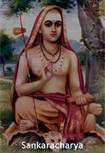
About the middle of the 7th century A.D. Buddhism was in a state of decline. Its final defeat is attributed to Kumarila Batta and Sankaracharya. Kumarila was the founder of the Bhattapada school of Karma-mimamsa and was a great opponent of Buddhism. For his hand, he took the Vedas and vedik rites as the basis. Sankara who lived in the later part of the 8th century and the earlier part of the 9th century completed the work started by Kumarila, and much more.  Sankara assimilated some of the good points of Buddhism. Never deploring the Vedik rites and rituals , he purified them by removing those parts which are misused. He erected the edifice of Advaita and established  four monasteries  as centres of religious teaching and missionary work. These mathas,to this date, are the sources of light and wisdom to millions of Hindus.

THE STATE OF HINDUISM :- 3.

Image
EPICS AND PURANAS:- The subsequent years saw the growing popularity of the Epics and Puranas. They were the most valuable for the common people and formed the source of half of the vernacular literature. One of the significant  developments in the advance of the religious thought in the Puranas was the doctrine of  Avataras  and the concept of  Sakti  personified as the Mother Goddess.   Saktism gave rise to a mass of religious literature known as Tantras. Unlike the Puranas  they contain more of ritualistic matter and less of legend and history. The period up to above 7th century A.D. may be called the period of the puranas and dharshans. This period saw the compilation of eighteen great puranas, the famous dramas of Bhasa and Kalidasa and other commendable masterpieces like the mathematical treatise of Aryabhatta, the  astronomical  treatise of Varahamitra, etc. The Silpa sastra is also ascribed to this period.