Posts

Sri Ramanujacharya Life History : 4.
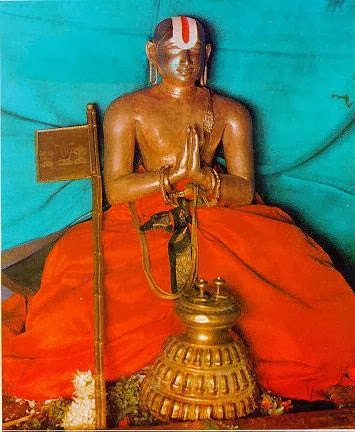
Image
EVENTS IN THE LIFE OF SRI RAMANUJA (1) Within 16 years of age, he had mastered all the Vedas and Sastras. At age 17, he married Rakshakaambaal ( Tanjammal, in Tamil) (PPM)  (2) Ilaya Perumal was placed under the Advaitic Sannyasi called YADAVA PRAKASA at Tirupput kuzhi for training in Advaita Purva Paksha Sastra of Vedanta. Once during this period, Alavandar who desired nominating Ilaya Perumal to succeed himself visited Tirupput kuzhi, met with him but had no opportunity to speak to him and had to return to Srirangam.  Very many occasions arose when the Saivite Guru clashed with Ilaya Perumal when the Guru misinterpreted Vedantic statements. Ilaya Perumal fearlessly pointed out the errors in the Guru's interpretations and corrected him. This enraged the Guru. Fearing that one day, Ilaya Perumal would demolish Advaita philosophy, he plotted to kill Ilaya Perumal by drowning him in Ganga while on a pilgrimage tour of the country with his disciples.  Learni...

Sri Ramanujacharya Life History : 3.

Image
HIS BIRTH::CHITRAI- TIRUVADHIRAI) His date of birth is placed differently by different authorities.As per PPM, he was born in Kaliyuga year 4119 which corresponds to1017 AD. PPM fixes even the exact date as 13th April 1017 AD, interms of English Calendar.  PRA, though notes the year as 4118 Kali , maintains the year as 1017 AD only and gives additional information that the Rasi was Karkataka and the time of birth was exactly at noon.  VAC, MKS and MSR also agree on the year 1017. PTA gives a few more details like the Yogam being Ayushman, Karanam being Bhadra, Gotra being Harita, Saakha being Yajus, Sutra being Apasthambha and Sect being Vadama ( Vide p.45 of GLE).  PPM and ATA mention the year as Pingala, month Chitrai and the constellation Tiruvadirai. PPM adds that it was a Sukla Paksha Panchami, a Friday.  It will be for the Research minded scholars to piece together all these details to arrive at the correct date, time etc.  Vriddha P...

Sri Ramanujacharya Life History : 2.

Image
HIS AVATARA AND EARLY DAYS  : Ilaya Perumal was born to Kesava Perumal Somayaji Dikhsitar and Kanthimathi Ammal at Sriperumpudur. Just as Sage Vasishta on seeing the brilliance in the face of the child named him as Lakshmana saying "Lakshmano Lakshmi Sampannaha", Periya Thiru malai Nambi struck by the Tejas of the child, named him after Lakshmana as Ilaya Perumal. (PPM) aka Ilayalwar.  There is a sloka in Yadhavaachala Mahatmyam which says:  Ananthah Prathamam Roopam Lakshmanascha Tathah Parah |  Balabadram Thritheeyasthu Kalou Kaschit Bhavishyathi ||  (meaning) It is the same who was Adhisesha first, Lakshmana after and Balarama in the third who is born as Sri Ramanuja in the Kali yuga. This Kaschit is taken by our Poorva Acharyas as referring to Ramanuja (PPM)  Next :  HIS BIRTH::CHITRAI- TIRUVADHIRAI) Continues...

Sri Ramanujacharya Life History : 1

Image
Introduction Sri Ramanuja (1017 - 1137 CE), the most important philosopher-saint of Sri Vaishnavam and one of the most dynamic characters of Hinduism. He was a philosophical as well as a social reformer, displaying a catholicity that was nearly unparalleled in Hindu religious history before him. He revitalized Indian philosophy and popular religion so much that nearly every aspect of Hinduism has been influenced by his work. His life and works show a truly unique personality, combining contemplative insight, logical acumen, catholicity, charismatic energy, and selfless dedication to God.  The less known fact even among Srivaishnavas about this well known Acharya by whose name Srivaishnava philosophy is called 'Ramanuja Darsanam' and who is hailed as "Sri Vaishnava Siddhanta Nirdhaarana Saarva bouma" is that he was a 'Vadama' by birth.(Authority :" Periya Thrumudi Adaivu, Pazhanadai Vilakkam and Visishtaadvaita Catechism" - quoted in G...

Adi Sankaracharya : 6.

Image
Sankara's Philosophy Sankara wrote Bhashyas or commentaries on the Brahma Sutras, the Upanishads and the Gita. The Bhashya on the Brahma Sutras is called Sareerik Bhasya. Sankara wrote commentaries on Sanat Sujatiya and Sahasranama Adhyaya. It is usually said, “For learning logic and metaphysics, go to Sankara's commentaries; for gaining practical knowledge, which unfolds and strengthens devotion, go to his works such as Viveka Chudamani, Atma Bodha, Aparoksha Anubhuti, Ananda Lahari, Atma-Anatma Viveka, Drik-Drishya Viveka and Upadesa Sahasri”. Sankara wrote innumerable original works in verses which are matchless in sweetness, melody and thought. Sankara’s supreme Brahman is Nirguna (without the Gunas), Nirakara (formless), Nirvisesha (without attributes) and Akarta (non-agent). He is above all needs and desires. Sankara says, "This Atman is self-evident. This Atman or Self is not established by proofs of the existence of the Self. It is not possible...

Adi Sankaracharya : 5.

Image
Mother’s Funeral Rites Sankara received news that his mother was seriously ailing. He left his disciples and proceeded to Kaladi alone. His mother was then bedridden. Sankara touched her feet in reverence. He praised Lord Hari. Hari’s messengers came. Sankara's mother gave up her physical body and went along with those messengers to the abode of Hari. Sankara encountered serious difficulties in performing the funeral rites of his mother. Usually, Sannyasins do not perform any of the rites or ceremonies which are enjoined on the householders. The Nambudiri Brahmins were all against Sankara. Sankara's relatives also did not help him. They did not come forward to assist him even in carrying the dead body to the place of cremation and refused to give fire for igniting the funeral pyre. At last Sankara determined to perform the funeral rites all alone. As he could not carry the entire dead body, he cut it into pieces and removed the pieces one by one to the b...

Adi Sankaracharya : 4.

Image
Sankara's Digvijaya Sankara's philosophical conquests are unique in the world. He had his triumphant tour all over India. He met the leaders of different schools of thought. He convinced them by arguments and established the supremacy and truth of the religion that he expounded in his commentaries. He went to all the celebrated seats of learning. He challenged the learned men to discussion, argued with them and converted them to his opinions and views. He defeated Bhatta Bhaskara and condemned his Bhashya (commentary) on the Vedanta Sutras. He then met Dandi and Mayura and taught them his philosophy. He then defeated in argument Harsha, author of Khandana Khanda Kadya, Abhinavagupta, Murari Misra, Udayanacharya, Dharmagupta, Kumarila and Prabhakara. Sankara then proceeded to Mahishmati. Mandana Misra was the chief Pundit of the court of Mahishmati. Mandana was brought up in the Karma Mimamsa faith and so he had intense hatred for the Sannyasins. He was performing...