Posts

The Rise of the Itihasas (Epics) and Puranas :

Image
The Brahmam of the Upanishads, which stirred the awe and reverence of the sages, could be realised only by the cream of mankind, and those who are fit to pursue the path chalked out in the Upanishads are small in number. But religion has to extend beyond realisation and cater to the emotional needs of the lesser category of humanity. No historian of philosophy, to our knowledge, has been able to get over the prejudice that all religious thought subsequent to the Vedas and Upanishads, and apart from the later systematic Vedanta of the Darsana school, is a kind of trash, or, at best, a concession to the weakness of the popular mind. But it need not be emphasised that, if the religion of the Hindus had exhausted itself in the visions of the Vedas and Upanishads and the metaphysics of the intellectual Vedanta, Hinduism would have died out long ago and remained today as a memory, like the cultures of Babylon, Greece or Egypt. The almost universal sweep of the thought of the Hindu...

The Origin of the Valmiki Ramayanam :

Image
Srimad Valmiki Ramayana, which is considered as the Adi Kavya, equivalent to Veda itself, is something whose exposition it is rare to obtain. Vedah prachetasadasit sakshat ramayanatmana is a famous verse which makes out that the whole of the Veda has been expounded in epic language by the Adi Kavi Valmiki in the Ramayana. The power, the force, the literary style, the mellifluous movement of the whole theme of presentation and a subtly permeating undercurrent of immortal power in the whole epic of the Ramayana make it an almost unparalleled scripture in the world. All Sanskrit literature originated in its form as sahitya from the time of Sage Valmiki himself. There was, as we are told, no versification or presentation of any subject in the form of a sloka before Valmiki for the first time uttered words which became a sloka [verse] though what he expressed to all is a shoka [sorrow]. Manishada pratishtatum samagah sashvatisamah yat krouncha mithunadekam sokam avadhim kama m...

Swami Udit Chaithanya :

Image
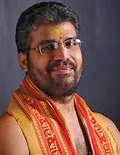
Swami Udit Chaithanya was born and brought up in Kerala, the beautiful green state in the southern west part of India. After graduating in Law, Swamiji joined Sandeepani Sadhanalaya in Bombay. Finishing his post graduation in Vedanta, he became a part of the Chinmaya mission and served the organisation for 3 years. He was inspired by Swami Sevananda who was the secretary of Acharya Vinoba Bhave when he discovered a new dimension in Sevanandaji's unique interpretations of India's ancient spiritual texts. Ever since, Swamiji has been teaching the messages of Srimad Bhagavatham, Bhagavad Gita, Narayaneeyam and the other Holy Scriptures to thousands of people in India and abroad. Swamiji has dedicated his life to the mission of spreading the divine message and to transform the society and the individual through heightened spiritual awareness. Swami Udit Chaitanya is the founder of Bhagavatham village, a spiritual retreat home and Swamiji  has formed “Bhagav...

SRI AUROBINDO :

Image
Sri Aurobindo was born in Calcutta on 15 August 1872. At the age of seven he was taken to England for education. There he studied at St. Paul's School, London, and at King's College, Cambridge. Returning to India in 1893, he worked for the next thirteen years in the Princely State of Baroda in the service of the Maharajah and as a professor in Baroda College. During this period he also joined a revolutionary society and took a leading role in secret preparations for an uprising against the British Government in India. In 1906, soon after the Partition of Bengal, Sri Aurobindo quit his post in Baroda and went to Calcutta, where he soon became one of the leaders of the Nationalist movement. He was the first political leader in India to openly put forward, in his newspaper Bande Mataram, the idea of complete independence for the country. Prosecuted twice for sedition and once for conspiracy, he was released each time for lack of evidence. Sri Aurobindo had begun th...

2. BRAHMARISHI VASHISHTA :

Image
Ancient Rishis of Bharatham : Brahmarishi Vashishta Brahmarishi Vashishta was the manasputra of Lord Brahma of the first Yuga of the creation. His wife was Arundhati. When Lord Brahma asked him to become the priest of the 'Surya-Vansha' (descendants of the Sun god), Vashishta declined. Since, he was free from greed for wealth, hence he disliked the idea of doing a mean job like that of a priest. But when Lord Brahma said that Lord Vishnu would take an incarnation in this very 'Surya-Vansha', Vashishta agreed to accept this designation.   Initially, Vashishta acted as the priest for whole of the Suryavansha, but often he had altercation with 'Nimi', he quit all the other branches of the Suryavansha and he made his hermitage near Ayodhya and acted as a priest only for 'Raghuvansha' (descendant of Raghu).   Whenever a famine occurred or there was no rainfall in Ayodhya, he came to the rescue of the subjects by the powers achieved from penance...

1. Viswamittra Mahrishi :

Image
Ancient Rishis of Bharatham :1.  The three chief classes of Rishi are the Brahmarshi, born of the mind of Brahma, the Devarshi of lower rank, and Rajarshi or Kings who became Rishis through their knowledge and austerities, such as Janaka, Ritaparna, etc. The Shrutarshi are makers of Shastras, as Sushruta. The Kandarshi are of the Karmakanda, such as Jaimini.  Sapta rishis are two Sanskrit words meaning "Seven Sages".  Some of the great Rishis (sages) of India are:   1. Viswamittra Mahrishi : Rishi Viswamitra is considered to be one of the most revered rishis (sages) of the ancient India. As per the holy Puranas, there have been only 24 Rishis in India who have the Gayatri Mantra. It is believed that Sage Vishwamitra is the first saint of the 24 saints, and Sage Yajnavalkya the last. He also claims the distinction of being the author of the majority portion of the Mandala 3 of the Rig-Veda. Read on to explore the biography of Sage Vishwamitra furth...

Rishi Dattatreya :

Image
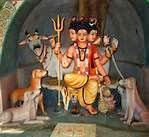
: The story of Dattatreya is told in many Purana-s, and this is from the Markandeya purana (chapter 15). A brahmin named kaushika was enchanted by a courtesan and lost his wealth, health etc. However, his wife, Shandili was faithful to him. She even carried him on her shoulders to the courtesan's place. Once, by mistake, she stepped on Sage Mandavya and the sage cursed both of them to die by sunrise. Shandili prayed and appealed that the sun may never rise so that her husband would live. Her prayer was answered and the devas were in an uproar seeing the world order of time destroyed. They asked for the help of Anusuya, the wife of sage atri, to convince shandili. Anusuya was able to convince shandili on the condition that kaushika would live on sunrise. In appreciation of Anusuya's intervention, the gods granted her three boons. She asked for her liberation, her husband's liberation and that the three gods Brahma, Vishnu and Shiva be born as sons to her. The wish...