Posts

Two Topics in the Veda :

Image
  A human being has a number of desires.  And the desires of a given person need not be the desires of another person.  Further, a person who has a desire now many not have the same desire later even though it was not fulfilled.  He may grow out of it.  Thus, these desires (kamah) are many and varied (binnah).  In order to fulfill these desires, a person makes attempts according to his skill and knowledge, but still, there are many hidden variables.  To control the hidden variables one resorts to prayer This kind of prayer, a specific prayer to get a given result is mentioned in the first part of the Veda There are many such prayers for the many different ends.  Finally, at the end, the Veda has a topic called Vedanta.  This topic deals with the desirer.  It is important to understand the difference between these two topics.  One deals with your desires; it tries to help you to fulfill your desires. ...

Article in Indian Express by Pujya Swamiji , "Need to Understand Secularism" :

Image
The aspiration of those who amended the Constitution to call India a secular nation is a noble one. Secularism, as originally conceived, embodies basic principles that implement and nurture universal values. Thereby, it fosters a state that is harmonious and, in harmony with the Lord. However, one may know or is taught that the Lord and ethical behaviour are inextricable. The essence of such behaviour is captured in a single guideline that is found in all religions—the ethic of reciprocity. Popularly known as the golden rule, it mandates, “Do to others as you would want them to do to you.” This maxim that guided humans throughout history is traceable to ancient religious traditions all over the world. It is so pervasive because it is based on a special human endowment, empathy. Empathy is the capacity to sense the pain of another being and act appropriately. And the extent to which this empathy is honed is a mark of one’s evolution as a human being seeking harmony with the Lord...

The Truth of Srimad Bhagavatam : 2.

Image
The conception of God and the conception of Absolute Truth are not on the same level. The Srimad-Bhagavatam hits on the target of the Absolute Truth. The conception of God indicates the controller, whereas the conception of the Absolute Truth indicates the summum bonum or the ultimate source of all energies. There is no difference of opinion about the personal feature of God as the controller because a controller cannot be impersonal. Of course modern government, especially democratic government, is impersonal to some extent, but ultimately the chief executive head is a person, and the impersonal feature of government is subordinate to the personal feature. So without a doubt whenever we refer to control over others we must admit the existence of a personal feature. Because there are different controllers for different managerial positions, there may be many small gods. According to the Bhagavad-gita any controller who has some specific extraordinary power is calle...

The Truth of Srimad Bhagavatam : 1.

Image
We must know the present need of human society. And what is that need? Human society is no longer bounded by geographical limits to particular countries or communities. Human society is broader than in the Middle Ages, and the world tendency is toward one state or one human society. The ideals of spirituality , according to Srimad-Bhagavatam, are based more or less on the oneness of the entire human society, nay, of the entire energy of living beings. The need is felt by great thinkers to make this a successful ideology. Srimad-Bhagavatam will fill this need in human society. It begins, therefore, with the aphorism of Vedanta philosophy to establish the ideal of a common cause. Human society, at the present moment, is not in the darkness of oblivion. It has made rapid progress in the field of material comforts, education and economic development throughout the entire world. But there is a pinprick somewhere in the social body at large, and therefore there are large-scale q...

Meditaion gives relaxation and rejuvenation to your mind and body :

Image
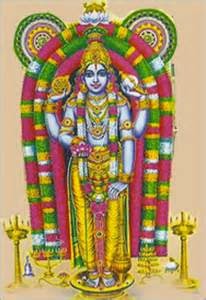
First imagine the form of the Lord from top to bottom. Slowly focus your mind on the form of the Lord. Then find out your self “Who gives existence to the mind?” There you have to understand and experience divinity. (Such a person can accept every thing and negate whatever negative experience influences him. He can turn adversities into advantages). Steps for meditation : Ensure physical cleanliness. Choose a clean place; ideally have a permanent room for doing Sadhana. Sit on a “natural fibre” mat. Do not use a plastic material. Light up a lamp. Sit in a comfortable posture. Keeping your hands in “CHIN MUDRA” (thumb touching the tip of forefinger), sit in an erected posture without bending. Do Pranayam keeping your mind and body alert. Visualize the form of the Lord. Recite Japam; after each Japam, mentally offer flowers at HIS feet (for at least 20 minutes). After surrendering there, every thing should disappear – body, mind or even the feet of the Lord....

Abhimanyu :

Image
Abhimanyu is a brave and tragic hero in the Hindu epic, the Mahabharata. He is the son of Arjuna and Subhadra, the half-sister of Lord Krishna. As an unborn child in his mother's womb, Abhimanyu learns the knowledge of entering the deadly and virtually impenetrable Chakravyuha   from Arjuna.The epic explains that he overheard Arjuna talking about this with his mother from the womb. Arjuna spoke about entering Chakravyuha and later Subhadra dozed to sleep. Arjuna stopped explaining Chakravyuha escape when he saw Subhadra slept while listening. As an effect, the baby Abhimanyu in womb didn't get a chance to know of coming out of it.  Abhimanyu spent his childhood in Dwaraka, his mother's city. He was trained by Pradyumna, the son of Sri Krishna and his great warrior father Arjuna and brought up under the guidance of Lord Krishna. His father arranged his marriage to Uttara, daughter of king Virata to seal an alliance between the Pandavas and the royal famil...

Meditation Technique : 1.

Image
Meditation is the mental enrichment with positive energy. As the body needs the food, mind needs positive energy. A positive mind alone can become a strong mind. Today we are disturbed because of ill health, stress and strain, competition and criticism from others, al because of our weak mind. A weak minded person always justifies himself by blaming others and situations. A strong minded person thinks creatively, acts positively and accepts boldly. Through meditation we can develop a positive mind which accepts every thing rejects nothing. It learns even from enemies and turn al adversities into advantages. A positive minded person is always active and Time provides him with lot of opportunities. Such a person can never fail in life. For a beginner, the meditation technique can be as follows: step 1. Sit in a comfortable erect position (Sukhasan, Padmasan, Artha Padmasan or Vajrasan etc) on a mat. Take a deep breath in, then hold breath, recite AUM as lengthy as ...