Posts

Great Leaders of Bharatham : 6.

Image
Maulana Abul Kalam Azad  : Born: November 11, 1888 Died: February 22, 1958 Contributions : Maulana Abul Kalam Azad Maulana Abul Kalam Azad was a renowned journalist of his time. Disturbed by his provocative articles, the British Government decided to deport him off Calcutta. Despite of his house-arrest and imprisonment, Maulana Abul Kalam Azad continued to write against the anti-people policies of the British Government. He was elected as Congress President in 1923 and 1940. Despite being a Muslim, Azad often stood against the policies of the prominent Muslims leaders like Muhammad Ali Jinnah. Azad was the first education minister of independent India. On February 22, 1958 Maulana Abul Kalam Azad passed away. Maulana Abul Kalam Azad was posthumously awarded, Bharat Ratna, India's highest civilian honor, in 1992. Life :  Maulana Abul Kalam Azad was born on November 11, 1888 in Mecca, Islam's main center of pilgrimage. His forefather's came to India dur...

Great Leaders of Bharatham : 5.

Image
Lala Lajpat Rai : Born: January 28, 1865 Died: October 30, 1928 Contributions : Lala Lajpat RaiLala Lajpat Rai immensely contributed in attaining independence the nation. He helped in establishing few schools in the country. He also initiated the foundation of Punjab National Bank. In 1897, he founded the Hindu Orphan Relief Movement to keep the Christian missions from securing custody of these children. He died after the police lathi-charged on the activists, protesting the arrival of Simon Commission. Life :  Lala Lajpat Rai was born on January 28, 1865 to Munshi Radha Krishna Azad and Gulab Devi at Dhudike village in Ferozpur District. His father was a great scholar of Persian and Urdu while his mother was a strict religious lady and inculcated in her children strong morals values. His family values allowed Lajpat Rai, the freedom of having different faiths and beliefs.  Lajpatrai received his elementary education in the school where his father was ...

Great Leaders of Bharatham : 4.

Image
Gopal Krishna Gokhale : Born: May 9, 1866 February: 19, 1915 Contributions :  Gopal Krishna Gokhale was one of the pioneers of the Indian Independence Movement. Gokhale was a senior leader of the Indian National Congress. He was one of the most learned men in the country, a leader of social and political reformists and one of the earliest and founding leaders of the Indian Independence Movement. Being one of the first generations of Indians to receive college education, Gokhale was respected widely in the Indian intellectual community. Life:  Gopal Krishna Gokhale was born in Kothluk in Ratnagiri District, Maharastra. His parents, Krishna Rao and Valubai. Gokhale received his early education at Rajaram High School in Kothapur and later, in 1884 moved to Bombay to receive higher education.  Gokhale was reportedly, one of the first Indians to complete graduation. In 1884, after the completion of his graduation in arts at the Elphinstone College, Bom...

Great Leaders of Bharatham : 3.

Image
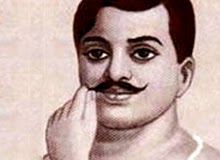
3. Chandrasekhar Azad : Born: July 23, 1906 Passed Away: February 27, 1931 Contributions : Chandrashekhar AzadA contemporary of Bhagat Singh, Chandrasekhar Azad was a born firebrand revolutionary. He engaged in a heroic battle against the British. His role was crucial in inspiring the others of his generation to participate in the national movement for freedom. Life:  Chandrasekhar Azad was born to Pandit Sita Ram Tiwari and Jagrani Devi on July 23, 1906 in Badarka (Unnao). His original name was Chandrasekhar Tiwari.  He received his early schooling in Bhavra District in Jhabua, Madhya Pradesh. For higher studies he went to the Sanskrit Pathashala at Varanasi. Chandrashekhar was deeply troubled by the Jalianwalabagh massacre in Amritsar in 1919. Azad, at an age of 15, got involved in the revolutionary activities. He was caught by the British police while participating in the non-cooperation movement and sentenced to. whiplashes as punishment. When the ma...

Great Leaders of Bharatham : 2.

Image
2. Bhagat Singh : Born: September 27, 1907 Passed Away: March 23, 1931 Contributions : Bhagat Singh was among the prominent revolutionaries who shaped the base of a grand national movement. Following his execution, on March 23, 1931, the supporters and followers of Bhagat Singh regarded him as a "Shaheed", "martyr". Life :  Bhagat Singh was born on 27 September 1907 at Banga in Lyallpur district (now Pakistan) to Kishan Singh and Vidya Vati. From his early childhood, Bhagat Singh was imbued with the family's spirit of patriotism. At the time of his birth, his father Kishan Singh was in jail. His uncle, Sardar Ajit Singh, was a great freedom fighter and established the Indian Patriots' Association. He was well-supported by his friend Syed Haidar Raza, in organizing the peasants against the Chenab Canal Colony Bill. Ajit Singh had 22 cases against him and was forced to flee to Iran. Bhagat Singh was considered to be one of the most influen...

Great Leaders of Bharatham : 1.

Image
Bal Gangadhar Tilak Born: 23 July 1856 Passed Away: 1 August 1920 Contributions : Bal Gangadhar TilakBal Gangadhar Tilak was a social reformer and freedom fighter. He was one of the prime architects of modern India and strongest advocates of Swaraj (Self Rule). He was universally recognized as the "Father of Indian Movement". Tilak was a brilliant politician as well as a profound scholar who believed that independence is the foremost necessity for the well being of a nation.  Life: Bal Gangadhar Tilak was born on July 22, 1856 in a middle class family in Ratnagiri, a small coastal town in southwestern Maharashtra. Tilak's father, Gangadhar Shastri, was a noted Sanskrit scholar and school teacher at Ratnagiri. His mother's name was Paravti Bai Gangadhar. In 1886, following his father's transfer, the entire family shifted to Poona.  Tilak was a brilliant student and also very good in mathematics. Since his childhood, Tilak had an intoleran...

Sex Education :

Image
WHAT PLACE has... instruction in sexual science in our educational system, or has it any place there at all? Sexual science is of two kinds-that which is used for controlling or overcoming the sexual passion, and that which is used to stimulate and feed it. Instruction in the former is as necessary a part of child's education as the latter is harmful and dangerous and fit therefore only to be shunned. All great religions have rightly regarded kama as the arch-enemy of man, anger or hatred coming only in the second place. According to the Gita, the latter is an offspring of the former. The Gita , of course, uses the word kama in its wider sense of desire. But the same holds good of the narrow sense in which it is used here. This , however, still leaves unanswered the question, i.e., whether it is desirable to impart to young pupils a knowledge about the use and function of generative organs. It seems to me that it is necessary to impart such knowledge to a certain extent....