Posts

Spiritual Import of Religious Festivals : Ch-2. Part-6.

Image
Ch-2.  Siva – The Mystic Night ( Sivaratri) Part-6. Likewise, this Mantra, the Satarudriya of the Yajurveda, a hymn to Lord Siva, has an objective meaning, a subjective meaning and a divine, supreme, supra-mental, universal meaning. Objectively, it is a prayer for the control of the forces of nature. Subjectively, it is a prayer for self-control and the rousing of the spiritual consciousness. Universally, it is a surge of the soul towards God-realisation. It has an Adhiyajnika, Adhibhautika, Adhidaivika and Adhyatmika meaning, as we usually put it. It has a tremendous meaning. The Vedas, the Mantras of the Vedas, are filled with such threefold or fourfold meaning. Hence it is difficult to understand the full meaning of any Mantra of the Veda. "Ananta vai vedah": Infinite is the meaning of the Vedas. The meaning of the Vedas is infinite. It has no end at all. It is mathematics; it is chemistry; it is physics; it is Ayurveda; it is psychology; i...

Spiritual Import of Religious Festivals : Ch-2. Part-5.

Image
Ch-2.  Siva – The Mystic Night ( Sivaratri) Part-5. In the famous Rudra-Adhyaya or the Satarudriya of the Yajur Veda, we have a majestic, universalised description of Lord Siva, a chant which we are accustomed to every day in the temple. Only those who know what Sanskrit is, what the Vedas are and what worship is, can appreciate what this Satarudriya chant also is. It is one of the most powerful prayers ever conceived by the human mind. It is filled with a threefold meaning. According to the culture of this country, everything is threefold – objective, subjective and universal. Everything in the world, from the smallest to the biggest, has an objective character, a subjective character and an universal character. Objectively you are something, subjectively you are another thing and universally you are a third thing. It all depends upon the point of view from which you interpret a particular thing, person or obj ect. When you obj ectively interpret a thi...

Spiritual Import of Religious Festivals : Ch-2. Part-4.

Image
Ch-2.  Siva – The Mystic Night ( Sivaratri) Part-4. We observe fast during the day and vigil during the night. The idea is that we control the senses, which represent the outgoing tendency of our mind, symbolised in fasting, and we also control the Tamasic inert condition of sleep to which we are subject every day. When these two tendencies in us are overcome, we transcend the conscious and the unconscious levels of our personality and reach the superconscious level. While the waking condition is the conscious level, sleep is the unconscious level. Both are obstacles to God-realisation. We are shifted from one condition to another. We are shunted, as it were, from waking to sleep and from sleep to waking, every day. But the super-conscious is not known to us. The symbology of fast and vigil on Sivaratri is significant of self-control; Rajas and Tamas are subdued, and God is glorified. The glorification of God and the control of the senses mean one and the sam...

Spiritual Import of Religious Festivals : Ch-2. Part-3.

Image
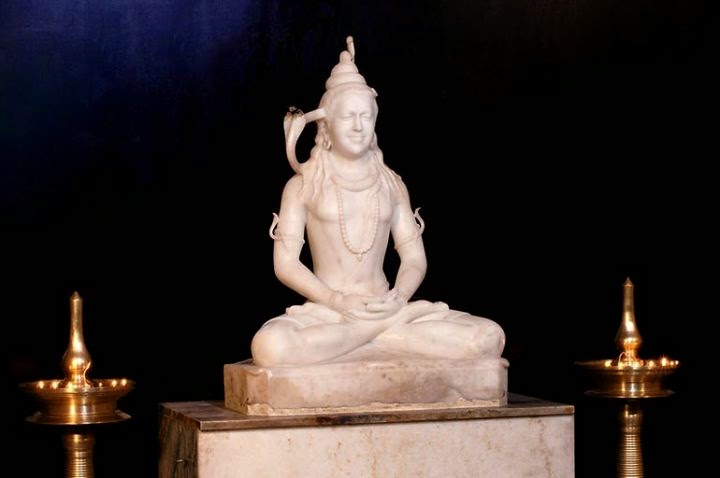
Ch-2.  Siva – The Mystic Night ( Sivaratri) Part-3. God does not possess things. Possession is a relationship of one thing with another thing. But, God is super-relative. That is why we call Him the Absolute – He is not relative. Anything that is related to something else comes under the category of relative. God is not related to anything else, because He is All-comprehensive. And, thus, in His all-comprehensive Absoluteness, which is height of wisdom conceivable, there is also the concomitant character of freedom from the consciousness of externality, and therefore, as a corollary, freedom from attachment to anything. Thus Lord Siva is the height of austerity, Master Yogin, portrayed as seated in a lotus pose, as the king of all ascetics; not that He has the desire for self-control, but He is what self-control is itself. He does not practise self-control. Self-control itself is symbolised in the personality of Lord Siva. "Such a wondrous concept of ...

Spiritual Import of Religious Festivals : Ch-2. Part-2.

Image
Ch-2.  Siva – The Mystic Night ( Sivaratri) Part-2. God does not renounce anything. Then, in that case what is renunciation in this context? It is the freedom from the consciousness of externality. This is called Vairagya. How can you abandon things? All things are there in front of you, like trees in a forest or stones in the jungle. There is nothing like abandonment of things, because they are internally related to you. Nobody can renounce anything, because everything in this world is connected to everything else. Then what is Vairagya? Vairagya is not renunciation of any object; it is impossible. Everything clings to you. But the idea that things are outside you, makes you get attached to them. This false attachment is Raga, and its absence is Viraga. The condition of Vi-raga is Vairagya. As God has no consciousness of externality, because everything is embodied in Him, there cannot be a greater renunciate than God. And in as much as this Consciousness of God ...

Spiritual Import of Religious Festivals : Ch-2. Part-1.

Image
Ch-2.  Siva – The Mystic Night ( Sivaratri) Part-1. We conceive God as glory, as creativity and as austerity. Vishnu is glory and magnificence, Brahma is creativity force, and Siva is austerity and renunciation. You might have heard it said that God is the embodiment of six attributes of which renunciation is one. You will be wondering how God can renounce things. He is not a Sannyasin. He is not an ascetic like a Vairagin or a Sadhu. What is He going to renounce? How do you conceive Siva as an austere Yogin or a renunciate? What does He renounce? The all-pervading Almighty, what has He to give or abandon? Here is the secret of what renunciation is! It is not renunciation of anything, because there is nothing outside Him; renunciation does not mean abandonment of object. If that had been the definition of renunciation, that cannot apply to God. God does not renounce or abandon any object, because all objects are a part of His Cosmic Body. Then how do you represent God ...

Spiritual Import of Religious Festivals : Ch-2. Introduction.

Image
Ch-2.  Siva – The Mystic Night : ( Maha Sivaratri ) Introduction : Today  is : ( Tuesday, February 17, 2015.) - Maha Sivaratri. Part-1. "Nature specializes in a kind of Paradox: Nature destroys and her destructions are all always constructive destructions. The bud is destroyed when the flower blooms, and the flower fades when the fruit emerges, and the fruit decays when seeds are scattered and seeds decay when plants sprout. This process of constructive destruction is Shiva, the annihilator. This Shiva-Ratri is the destruction of the ego (PFT attitude) in the discovery of the Self (Shiva). May all devotees come to experience at least the shy rays of the early dawn at the end of one's inner ratri, in emerging beams of Shiva spirit in us. Be quiet. Be silent within. Blind.Deaf, Mum - be. Invoke. Be expectant. Let Shiva happen - TRY." -Swami Chinmayananda Part-2. Shiva rathri celebrates the event by which Shiva saved the world. During Palazh...