Posts

Spiritual Import of Religious Festivals :Ch-4. Part - 4.
Image
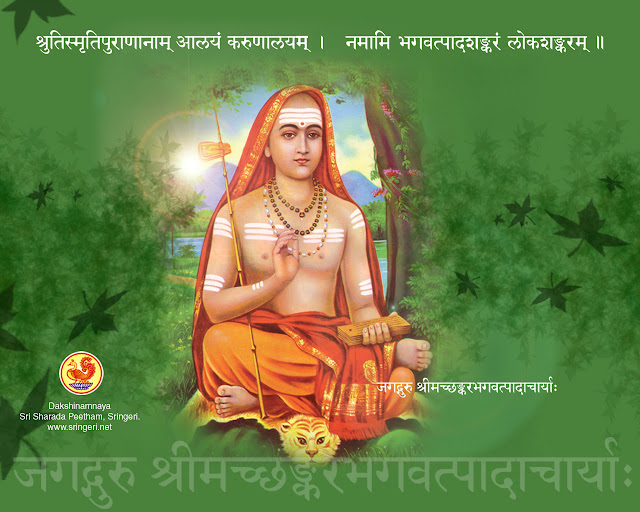
Chapter-4. Swami Sri  Adi  Sankaracharya - The Genius ( Sankara Jayanti ) : Part-4. The most catholic definition of the Supreme Reality we have is given to us for the first time given in the body of the Rigveda Samhita : Ekam Sat – the One Being, One Reality, One Substance, One Existence that the sages recognise and designate as the manifold. In various ways they sing of the glories of this One Mighty Being. But on the other hand, for pure exoteric observation, it would rather look like an acceptance of polytheism or the worship of many gods, as if there is a real multiplicity of the realm of the Adhidaiva, as a counterpart to the multiplicity that we see in the realm of the Adhibhuta or the physical world. The variety of the physical world became the source of a susceptible feeling in the minds of people later on, through the passage of time, that, perhaps, the souls also are many and the gods also are many, because the objects in the world are many! ...
Spiritual Import of Religious Festivals :Ch-4. Part - 3.

Image
Chapter-4.Swami Sri  Adi  Sankaracharya - The Genius ( Sankara Jayanti ) : Part-3. It was a spontaneity of feeling which was, in a sense, a natural result of the intuition of the sages. Throughout the Samhitas, if we make a deep study of them, we will see spread out in various places, thoughts and devotional feelings in their various emphases and stresses, all beckoning the aspiration of the human soul to what is implied and what is hidden behind the manifested phenomena. Now here, in this psychological situation of mankind, we have a twofold significance from the point of view of cultural history. On the one hand, it was a visible expression of an inner realisation by which the sages plumbed the depths of infinity and proclaimed for all eternity and to all mankind : "Ekam sat viprah bahudha vadanti, Indram Varunam Mitram Agni...." All the variety, whether in the field of the Adhidaiva (the transcendent, the presiding principle) or the Adhibhuta (the ...

Spiritual Import of Religious Festivals :Ch-4. Part - 2.

Image
Chapter-4.Swami Sri  Adi  Sankaracharya - The Genius ( Sankara Jayanti ) : Part-2. This is the specific characteristic of the time of the Veda Samhitas – to visualise and to behold the Creator in what is created, and to see the One in the many. Destiny, perhaps, willed that this should be the beginning of our cultural history so far as it can be recollected by our memories and available data, historically as well as archaeologically. The Samhitas of the Vedas are spontaneous hymns and prayers offered to God in His multifaceted manifestation as this cosmos. To the sages of the Veda Samhitas, the rise of the sun was a manifestation of God. It was the glorious God Aditya that was rising. The dawn was a manifestation of divinity. Similarly, the sunset had its own glory, revealing the divinity of God. The heat of summer, the pouring rains, the cold of winter, and the changing seasons – all that is visible as well as conceptual became a vehicle for enshrinin...

Spiritual Import of Religious Festivals :Ch-4. Part - 1.

Image
Chapter-4.Swami Sri  Adi  Sankaracharya - The Genius ( Sankara Jayanti ) : Part-1. Vaisakha Sukla Panchami, the fifth day in the bright fortnight in the month of April-May, when we celebrate the advent of the great Acharya Sankara who is often referred to, by his followers, as Bhashyakara (the commentator on the Prasthana Traya – the Brahma Sutras, the Upanishads and the Bhagavadgita). The famous and unforgettable event of his life and work is a consequence of the chronology of social history as well as a consequence of the logic of human thought. The immortal service that he has done for the world is thus an outcome of a chronological process as well as a logical one. First of all, let us see what the chronological significance of the work of Acharya Sankara is, in the social history of India in particular and the world in general. Chronology is the sequence of history, and if we trace back the condition of the human society, particularly in India, durin...

Spiritual Import of Religious Festivals :Ch-3. Part - 24.

Image
Chapter-3. Rama – The Apotheosis of Human Perfection ( Sri Ramanavami ) Part-24. It is not a joke to face and overcome these great negative forces. They are awful – this is the only word we can use here. They are so terrifying that even a mere thought of them is enough to make one run away. Such is the terror that one has to meet with before one becomes fit for God-realisation. "The fear of the Absolute," said Plotinus, a great saint of the West. Entering the Absolute is like entering a lion's den, from which you cannot come back. Fierce is the ocean, fierce is the lion, fierce is the conflagration of fire, fierce is the love of God. No one can love God, unless one is prepared to die, wholly and totally, to the so-called good, beautiful and pleasant in this world, to this body and to the ego. Hard is the job! Difficult is the task! God's grace is the only saving factor. So, may we pray to Him, the Almighty, that He may bless us ...

Spiritual Import of Religious Festivals :Ch-3. Part - 23.

Image
Chapter-3. Rama – The Apotheosis of Human Perfection ( Sri Ramanavami ) Part-23. This should be the spirit of Sadhana and devotion to God – and nothing can be more difficult, because it is the death of the individual personality. "Die to live," as Gurudev Swami Sivanandaji Maharaj used to say. If you want to live in the Eternity, you have to die to the temporal, which means to say that you should die to all that you regard as beautiful, meaningful and valuable in this world. Who can do this? No ordinary man is prepared for this. No ordinary mortal can have the courage, the power and the strength to face the weaknesses of flesh, the foibles of human nature and the impetuosity of the human ego. Who can face these powerful demons? Who can face Ravana? No one, not all the gods, not even Indra could face him. And who are we? Swami Krishnananda To be continued  ...

Spiritual Import of Religious Festivals :Ch-3. Part - 22.

Image
Chapter-3. Rama – The Apotheosis of Human Perfection ( Sri Ramanavami ) Part-22. They respected God and so they were humiliated in the eyes of people, put down as 'no-ones' in the eyes of the world. What torture and what suffering they underwent – it is something terrifying, if you think over it. We have only to read the lives of a few saints of the past. We can read even the life of such a recent personality as Swami Sivanandaji. While it is easy to think that we believe in God, it is really difficult to be true to the salt. Hence, may we take these auspicious occasions as occasions for honest Sadhana of our own conscience and spirit also, and not the Sadhana of the hands, the limbs and the feet alone. We have the Sadhana of the limbs of the body, in the form of ritualistic worship with waving the lights in the temple, opening a scripture and reading it loudly through the vocal organ, and paying obeisance physically by Sashtanga Namaskara through th...